

TL;DR:
- A retail shelving layout involves strategically positioning units to maximize sales, visibility, and operational flow using planograms. Proper measurements, data-driven sequencing, commercial-grade fixtures, and disciplined execution are essential for optimal performance. Most layouts underperform because of poor planning, fixture quality issues, and lack of staff adherence and verification.
A retail shelving layout is the structured process of positioning shelving units, product categories, and customer pathways to maximise sales, product visibility, and operational flow. Done correctly, it is one of the highest-return investments a store manager can make. The industry term for a documented shelving arrangement is a planogram, and every effective retail shelving layout step by step process begins with one. Tools like SimplyDepo and Vision Group Retail have formalised this process, and commercial shelving suppliers such as DirectShopfittings provide the physical infrastructure to bring those plans to life. Get the sequence right and your shelving does the selling for you.
What measurements and prerequisites are vital before planning your shelving layout?
Before you sketch a single shelf position, you need hard numbers. Guessing at dimensions is the fastest route to a layout that looks right on paper but fails on the shop floor.
Standard commercial shelving dimensions set the baseline for all planning. Commercial gondola shelving typically comes in widths of 36 or 48 inches, with heights ranging from 48 to 84 inches. Aisle widths must be at least 36 to 48 inches to meet ADA compliance standards and give customers genuine comfort. These are not suggestions. They are the minimum specifications you build around.
The ‘Starter + Adder’ shelving model is one of the most underused cost controls in retail fit-outs. Rather than purchasing five complete shelving units for a 20-foot run, you buy one starter unit and four adder units. The Starter + Adder logic eliminates redundant upright posts between sections, saving both floor space and procurement cost. Most store owners discover this only after their first fit-out.
Gather these data inputs before you open any design software or draw any floor plan:
- POS sell-through metrics: which SKUs are moving and at what velocity
- Gross margin per SKU: high-margin products deserve prime shelf positions
- Fixture dimensions: exact measurements of every shelving unit you plan to use
- Inventory turnover rates: slow movers need less facing; fast movers need more
- Store traffic data: where customers enter, pause, and exit
Four key data inputs are required to build an effective planogram: POS sell-through, margin data, fixture dimensions, and inventory turnover. Without all four, your layout is based on opinion rather than evidence.
| Measurement | Standard Specification |
|---|---|
| Gondola shelf width | 36 or 48 inches |
| Gondola height range | 48–84 inches |
| Minimum aisle width | 36–48 inches |
| Starter + Adder run example | 1 starter + 4 adders for 20 feet |
Pro Tip: Measure your total run length before ordering shelving. A 20-foot wall run with 48-inch units requires five bays. Order one starter and four adders, not five full sets. You will save money and avoid redundant uprights cluttering your floor space.
Finally, map your customer flow before fixing any unit position. Customers in most UK stores move left on entry. Your highest-margin categories belong on the right side of the entrance, where dwell time is naturally higher.
How do you build a data-driven planogram step by step?
A planogram is not a decorative floor plan. It is a sales tool built from data, and the sequence in which you build it determines whether it works.

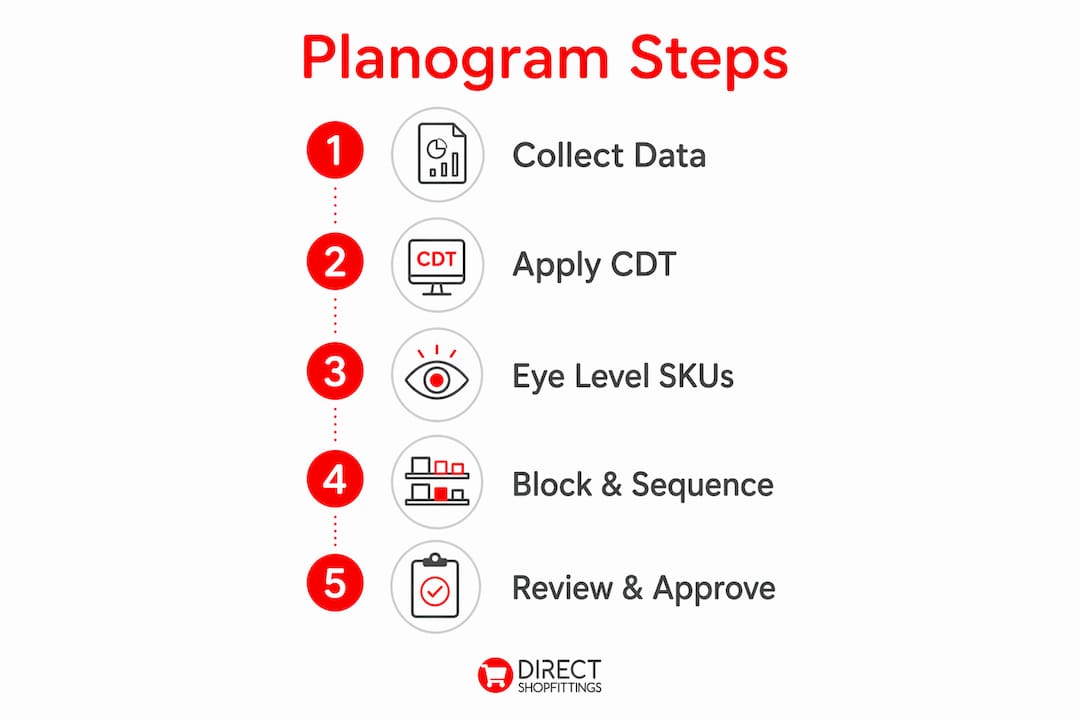
Step 1: Collect and verify your data. Pull your POS reports for the past 12 weeks. Identify your top 20% of SKUs by both volume and margin. These are your anchor products and they dictate shelf position before anything else is placed.
Step 2: Apply the Category Decision Tree (CDT). The CDT sequences products from left to right, mirroring shopper logic to reduce friction and improve navigation. A shopper looking for shampoo first decides on hair type, then brand, then size. Your shelf sequence should follow that exact decision path. Layouts that ignore CDT force shoppers to hunt, and hunting leads to abandonment.
Step 3: Place anchor SKUs at eye level. Eye level is the prime real estate of any shelving unit. Eye-level placement for priority SKUs, combined with logical horizontal and vertical sub-category grouping, drives both brand visibility and browsing ease. Place your highest-margin products at 120–160cm from the floor. Reserve lower shelves for bulk or value lines.
Step 4: Apply vertical blocking and horizontal sequencing. Vertical blocking groups a single brand or sub-category in a column from top shelf to bottom. Horizontal sequencing moves shoppers through a logical decision journey across the bay. Use both together for maximum clarity.
Step 5: Review, approve, and distribute. A planogram only works if every person involved in the reset receives the same approved version. Vision Group Retail recommends a formal review and sign-off process before distribution to field teams. Version control matters. An outdated planogram in the hands of a stock replenisher will undo weeks of planning.
Pro Tip: Planograms are not static documents. Adapt layouts for different store locations and local demographic preferences. A planogram that performs brilliantly in a city-centre convenience store may underperform in a suburban supermarket serving families.
The biggest misconception in retail layout is that it is purely aesthetic. Data-driven design, grounded in shopper behaviour and sales metrics, is what separates a layout that looks good from one that generates revenue.
Which shelving systems deliver the best performance in 2026?
Choosing the right shelving system is not a style decision. It is a structural and commercial one. The wrong fixture type will undermine even the best planogram.
Gondola shelving remains the workhorse of UK retail. Double-sided gondola units create mid-floor aisles and maximise product-facing capacity. Wall-mounted shelving suits perimeter runs and high-density storage. End caps, the shelving units at the end of each aisle, are premium positions that command the highest sales per square metre in most store formats.
High-density shelving layouts increase SKU capacity and revenue per square metre, but poor aisle flow harms staff restocking and customer navigation. The gains from packing in more product are quickly lost if your team cannot restock efficiently or if customers feel cramped.
The most common fit-out mistakes in 2026 include:
- Using domestic-grade shelving in commercial environments
- Ignoring operational flow for back-of-house staff
- Failing to plan for future scalability as product ranges grow
- Placing end caps without a promotional strategy to justify the premium position
Commercial-grade shelving systems provide scalability and durability that domestic-grade fixtures cannot match. A shelving unit rated for domestic use will bow under commercial stock loads within months. The cost saving on purchase becomes a replacement cost within a year.
| Shelving Type | Best Use | Key Consideration |
|---|---|---|
| Gondola (double-sided) | Mid-floor aisles | Requires 36–48 inch aisle clearance |
| Wall-mounted shelving | Perimeter runs | Maximises floor space |
| End cap units | Aisle ends | Premium position; needs promotional plan |
| Display fixtures | Feature products | Drives impulse purchases |
Pro Tip: When selecting a shelving supplier, ask specifically for engineered commercial-grade specifications and load ratings. A supplier who cannot provide load data per shelf is selling you domestic product at commercial prices. DirectShopfittings publishes full specifications for all units, which makes compliance checking straightforward.
For guidance on retail display mistakes that affect both small and large stores, the patterns are consistent: poor fixture choice and inadequate aisle planning account for the majority of underperforming layouts.
What are the best practices for executing and verifying your shelving layout?
Planning a layout is one discipline. Executing it accurately on the shop floor is another. The gap between the two is where most retail layouts fail.
Follow this sequence for every shelving reset:
- Clear and clean all shelves before beginning. Dust, old price labels, and residual stock left in place will cause placement errors and inaccurate facing counts.
- Adjust shelf heights to match the planogram specifications exactly. Even a 2cm variance in shelf height will misalign product facings and break the visual logic of the layout.
- Place products in the exact sequence shown on the planogram. Left to right, top to bottom. Do not allow staff to substitute positions based on what “looks better.”
- Count and verify facings against the planogram before signing off the reset. One missing facing on a high-velocity SKU costs real revenue across a trading week.
- Photograph the completed reset from a fixed position for every bay. Photo documentation creates an accountability record and provides the baseline for future layout refinement.
Precise fixture specifications are critical for planogram success. When field staff work from approximate dimensions, they improvise. Improvisation breaks the layout strategy and makes performance data unreliable.
Common real-world challenges during execution include:
- Staff repositioning products based on personal preference rather than the planogram
- Space mismatches caused by inaccurate fixture measurements taken at the planning stage
- Delivery timing issues leaving gaps on shelves during the reset window
- Inconsistent shelf height adjustments across a multi-bay run
Pro Tip: Photo documentation of every reset creates a lasting record that improves future sales data analysis. When you review performance data six weeks later, you need to know exactly what the shelf looked like on day one. Without photos, you are comparing sales data to a layout that may have drifted significantly from the original plan.
For practical guidance on shelf dimensions and planning, having the correct measurements documented before the reset begins eliminates the majority of on-the-day problems.
Key takeaways
An effective retail shelving layout requires precise measurements, data-driven planogram sequencing, commercial-grade fixtures, and disciplined field execution to convert shelf space into consistent revenue.
| Point | Details |
|---|---|
| Measure before you plan | Use standard gondola dimensions and verify aisle widths before ordering any fixtures. |
| Build planograms from data | POS metrics, margin data, fixture specs, and inventory turnover are all required inputs. |
| Apply the Category Decision Tree | Sequence products left to right following shopper logic to reduce friction and lost sales. |
| Choose commercial-grade shelving | Domestic-grade fixtures fail under commercial loads and cannot scale with your product range. |
| Verify and photograph every reset | Photo records create accountability and provide the baseline for future layout analysis. |
Why most retail layouts underperform before a single customer walks in
I have reviewed a lot of retail fit-outs over the years, and the pattern is almost always the same. The shelving looks fine. The store feels organised. But the layout was designed by eye rather than by data, and within three months the manager is wondering why certain bays are dead zones.
The Category Decision Tree is the single most underused tool in retail layout planning. Most store owners have never heard of it. Those who have often treat it as optional. It is not optional. It is the difference between a shelf that guides a shopper to a purchase and a shelf that makes them give up and leave.
The other consistent failure point is fixture quality. I have seen stores invest heavily in planogram software and layout consultancy, then fit out with shelving that bows under load within six months. The planogram becomes irrelevant because the physical reality no longer matches it. Commercial-grade shelving is not a luxury. It is the foundation that makes everything else work.
Field execution discipline is where even well-planned layouts break down. Staff rearrange products. Shelf heights drift. Facings get consolidated when stock runs low and never restored. The stores that maintain layout integrity are the ones with photo verification built into their reset process. It takes ten minutes per bay and it saves hours of troubleshooting later.
If you are a retail owner investing time in layout planning, invest equally in the execution process. A perfect planogram executed poorly will always underperform a good planogram executed precisely.
— Lee
How DirectShopfittings can support your shelving layout project
Getting the layout right on paper is only half the work. You need commercial-grade fixtures that match your planogram specifications exactly, delivered on time and ready to install.
DirectShopfittings supplies engineered retail shelving for stores of every size, from independent boutiques to large retail chains. Their range includes gondola shelving, wall-mounted systems, end cap units, and specialist display fixtures, all with full load ratings and specification sheets. Their supplier network means hard-to-find configurations are sourced efficiently, saving you time and procurement cost. Explore the full retail shelving range or visit DirectShopfittings directly to discuss your layout requirements with their team.
FAQ
What is a planogram in retail shelving?
A planogram is a visual document that specifies the exact position, facing count, and sequence of every product on a shelving unit. It is built from POS data, margin metrics, and fixture dimensions to maximise sales per shelf metre.
How wide should retail store aisles be?
Retail aisles must be at least 36 to 48 inches wide to meet ADA compliance requirements and provide comfortable customer navigation. Narrower aisles reduce dwell time and make restocking harder for staff.
What is the starter + adder shelving model?
The Starter + Adder model uses one full shelving unit with end uprights as the starting bay, then adds subsequent bays that share uprights with the previous section. This reduces redundant posts and lowers the total cost of a shelving run.
How often should a retail shelving layout be reviewed?
Planograms should be reviewed at least every 12 weeks, or whenever a significant change in sales data, new product introduction, or seasonal shift occurs. Planograms require flexibility to adapt to different store locations and customer demographics.
What is the most common mistake in retail shelving layout?
The most common mistake is using domestic-grade shelving in a commercial environment. Domestic fixtures cannot handle commercial stock loads, fail quickly, and cannot be scaled as product ranges grow, making them a false economy for any serious retail operation.