

TL;DR:
- Retail shelving load capacity includes separate ratings for each shelf and the entire system, both essential for safety. To prevent failure, store owners must calculate loads carefully, add a safety buffer, and verify compliance with load notices, which should be maintained regularly. Proper installation, correct component selection, and ongoing load management are critical to ensuring safe and effective shelving operation.
Retail shelving load capacity is the maximum safe weight a shelf or shelving system can support without risk of structural failure or damage to stock. Getting this wrong costs more than broken merchandise. It puts staff at risk, exposes your business to liability, and can bring an entire bay down mid-trading day. This guide covers how capacity is rated, how to calculate actual loads, what compliance requires, and how installation choices affect the numbers. Whether you run a small boutique or a large retail chain, understanding shelf weight limits is a non-negotiable part of store operations.
How is retail shelving load capacity determined and rated?
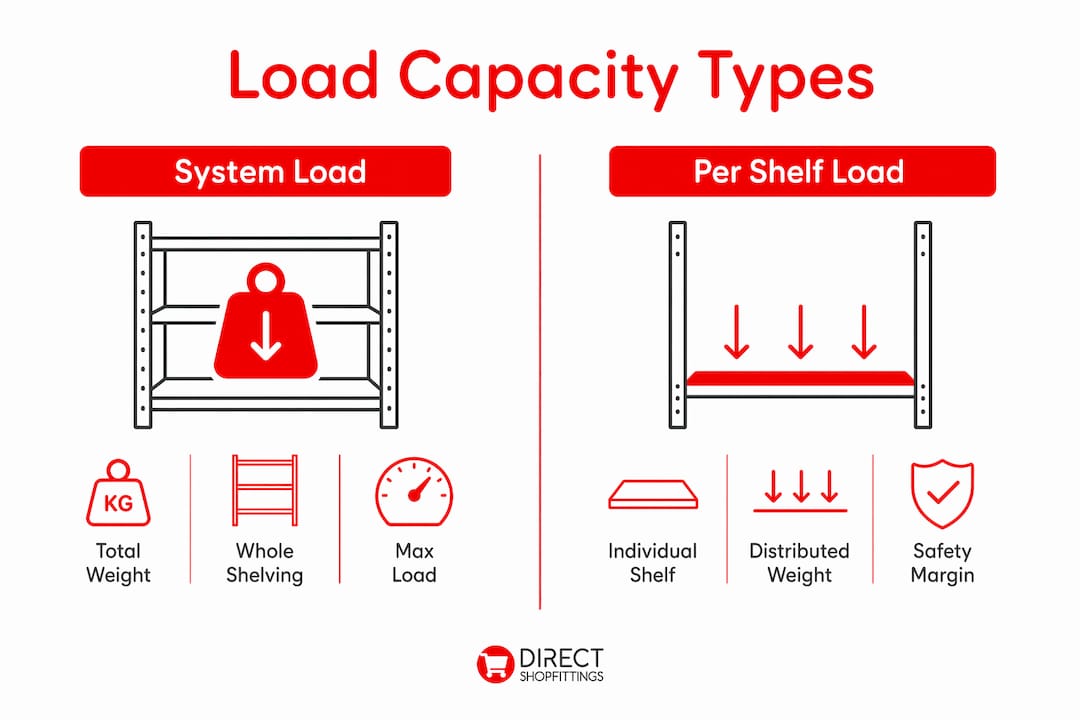
Retail shelf strength is defined by two separate figures: the total system rating and the per shelf level rating. These are not the same number, and confusing them is one of the most common and dangerous mistakes in retail. An RS PRO steel shelving system, for example, carries a 1,000 kg total load with a 200 kg maximum per shelf level. That means you cannot load all 1,000 kg onto a single shelf and expect it to hold.
Manufacturers derive these ratings through a concept called Uniform Distributed Load, or UDL. UDL assumes weight is spread evenly across the full shelf surface. A point load, such as a heavy box resting on a small area, creates concentrated stress that can exceed the UDL rating even when the total weight appears acceptable. Retail shelving specs are built around UDL, so point loads always require extra caution.
Shelf material and thickness directly determine bending limits and allowable load. Thicker steel shelves bear significantly heavier loads than MDF or plywood equivalents of the same dimensions. Beam size and bracket gauge also feed into the final rating. A shelf made from thin MDF with narrow brackets will deflect under loads that a steel equivalent handles without issue.
Key factors that affect shelf weight capacity
- Material: Steel outperforms MDF and plywood at equivalent thicknesses. Solid timber sits between the two.
- Thickness: A thicker shelf resists bending across longer spans.
- Beam and bracket size: Heavier gauge steel beams increase the rated load for the whole bay.
- Shelf span: The wider the shelf, the more it deflects under load. Shorter spans carry more weight safely.
- Mounting method: Wall-fixed systems transfer load to the structure. Freestanding units rely on their own frame integrity.
Rated capacity: system vs per shelf
| Rating type | What it means | Common error |
|---|---|---|
| Total system load | Maximum weight across all shelves combined | Treating it as a per shelf figure |
| Per shelf level load | Maximum weight on one individual shelf | Ignoring it when stacking heavy stock |
| UDL rating | Assumes even weight distribution | Applying it to concentrated point loads |
| Working load limit | 70–80% of rated capacity for daily use | Planning to the full rated maximum |
How do you calculate the actual load on retail shelves?
Calculating shelf load is a straightforward process when you follow a consistent method. The goal is to confirm that what you place on a shelf stays within its rated capacity, with a buffer for real-world variation.
- List every item on the shelf. Weigh each product or use the supplier’s stated weight. Include packaging.
- Add the shelf’s own dead weight. A steel shelf panel itself contributes to the load on its brackets and frame.
- Sum the total. Add item weights and shelf dead weight together.
- Apply a 10% safety buffer. Add 10% to your total to account for stock movement, uneven placement, and future changes to your range.
- Compare to the rated capacity. Your buffered total must sit below the per shelf level rating, not the system total.
- Check your working load limit. Use 70–80% of rated capacity as your practical planning ceiling, not the absolute maximum.
The 10% buffer exists for good reason. Safety margins cover real-world uncertainties including uneven load distribution, stock movement, and measurement errors. A shelf loaded to its absolute rated limit has no tolerance for a staff member adding one extra case of product at the end of a delivery.
Pro Tip: When you plan a new product range, calculate the heaviest possible shelf configuration first. If that figure exceeds 75% of the rated capacity, reconsider shelf spacing or move heavier lines to lower shelves closer to the floor.
Point loads deserve separate attention. A single heavy item, such as a large paint tin or a boxed appliance, concentrates weight on a very small area. Even if the total shelf weight is within limits, the local stress at that point can cause deflection or failure. Spread heavy items across the shelf surface and use load-distributing boards where necessary. For more on how shelf dimensions affect load distribution, the standard retail shelf dimensions guide from DirectShopfittings covers typical spans and their practical implications.
What are the safety and compliance requirements for shelf loads?
Load notices are the front line of shelving compliance. Every shelving bay in a retail or warehouse environment should display a notice showing the maximum beam load and maximum bay load. Load notices must be clearly displayed and kept current. If a notice is missing, unclear, or does not reflect the current configuration of the bay, treat the shelving as unrated until you can verify the limits with the supplier or a qualified inspector.
Operational controls like load notices are crucial cues for ongoing compliance and risk reduction, avoiding delayed damage or accidents.
Overloading shelving beyond its design limits causes stress, deflection, and potential failure over time. This is not always visible. A shelf can look perfectly level while the frame is accumulating fatigue stress that eventually leads to sudden collapse. The risk is not just to stock. A falling bay in a busy store is a serious injury hazard for staff and customers alike.
Compliance actions every store owner should take
- Display load notices on every bay and check them after any reconfiguration.
- Record the rated capacity of each shelving system at the time of purchase or installation.
- Conduct a visual inspection of all shelving at least once per quarter. Look for bent uprights, cracked welds, and shelf deflection.
- Brief staff on load limits during induction and refresh that training annually.
- Never mix components from different shelving systems without verifying compatibility and re-rating the bay.
How does installation affect shelving load capacity?
Installation quality directly determines how much weight a shelving system can safely hold in practice. A shelf rated at 200 kg per level can perform well below that figure if it is poorly anchored or incorrectly assembled.

Wall-mounted and floating shelves are particularly sensitive to fixing method. Shelves secured to studs carry significantly more weight than those fixed only with drywall anchors. In a retail context, this distinction matters most for wall-mounted display shelving. A shelf fixed into solid masonry or timber studs can handle meaningful product weight. The same shelf fixed into plasterboard with standard anchors cannot.
Installation factors that change the load limit
- Anchor type: Stud or masonry fixings outperform drywall anchors by a significant margin.
- Bracket count: More brackets reduce the span each one must support, increasing overall capacity.
- Bracket spacing: Brackets placed too far apart increase shelf deflection under load.
- Upright plumb: Uprights that are not perfectly vertical transfer load unevenly, reducing effective capacity.
- Floor levelling: Freestanding units on uneven floors concentrate load on fewer feet, stressing the frame.
Pro Tip: For freestanding gondola shelving in a retail environment, always use the anti-tilt feet or wall-tie brackets supplied by the manufacturer. These are not optional safety extras. They are part of the load-bearing design.
For wall-bracket options that include load ratings and fixing specifications, DirectShopfittings lists rivet racking wall brackets with clear capacity data to help you match the bracket to the load.
Common pitfalls and best practices for managing shelf loads
The most frequent mistake in retail shelving is treating the total system load rating as the per shelf limit. A system rated at 1,000 kg across five shelves does not mean each shelf holds 1,000 kg. It means the entire unit holds 1,000 kg combined. Clear internal load instructions prevent this error, but only if staff are trained to read and apply them.
A second common failure is ignoring changes to stock weight over time. A shelf configured for lightweight clothing accessories may later be used for heavier homeware products without any reassessment. The shelving capacity guidelines have not changed, but the actual load has increased well beyond the original plan.
Best practices for ongoing load management
- Label each bay internally with its per shelf and total system limits in plain figures. Do not rely on staff finding the original product documentation.
- Reassess loads whenever your product range changes. A new supplier, a seasonal range, or a category extension can all alter shelf weights significantly.
- Inspect after every major delivery. Heavy stock dropped onto shelves during a rushed delivery can cause immediate overload or cumulative damage.
- Replace damaged components immediately. A bent upright or cracked bracket reduces the rated capacity of the entire bay, not just the damaged section.
- Verify load data after any modification. Legacy load data becomes unreliable after non-standard components are introduced. A verification inspection is mandatory to confirm safe limits.
Uneven load distribution is a subtler problem. Retail staff naturally fill shelves from the front, leaving heavier stock at the back. This creates an uneven load profile that does not match the UDL assumption behind the rated capacity. Train your team to spread weight evenly across the shelf depth, not just the width. For a practical overview of how shelving layout affects load distribution, the retail shelving layout guide from DirectShopfittings is a useful reference.
Key takeaways
Retail shelving load capacity is defined by two separate ratings: the per shelf level limit and the total system limit. Planning to 70–80% of rated capacity, with a 10% safety buffer on calculated loads, is the standard approach for safe retail operations.
| Point | Details |
|---|---|
| System vs per shelf rating | Never treat the total system load as the per shelf limit. They are separate figures. |
| 10% safety buffer | Add 10% to your calculated load total before comparing it to the rated capacity. |
| Working load limit | Plan to 70–80% of rated capacity, not the absolute maximum. |
| Load notices | Display and maintain load notices on every bay. Verify them after any modification. |
| Installation quality | Anchor type, bracket count, and upright plumb all affect real-world capacity. |
What I have learned from years of watching shelving fail
The retail industry underestimates shelving load management until something goes wrong. I have seen bays collapse not because a single shelf was overloaded, but because nobody noticed that three shelves were each sitting at 90% of their rated limit while the system total had already been exceeded. The failure was slow, invisible, and entirely preventable.
The most practical thing any store owner can do is create a simple internal document listing every shelving bay, its per shelf limit, its system total, and the date of the last inspection. That document costs nothing to produce and removes the ambiguity that causes most overloading incidents. Staff do not overload shelves out of carelessness. They do it because nobody told them the limit.
I am also sceptical of the instinct to buy the cheapest shelving available and compensate with caution. A well-specified steel system with clear load data, proper brackets, and a supplier who can answer technical questions is worth the difference in price. The retail shop shelving buyers guide at DirectShopfittings is a good starting point for matching specification to actual retail use. Shelving is not a commodity purchase. It is a safety-critical piece of store infrastructure.
— Lee
Shelving solutions with clear load data from DirectShopfittings
Choosing shelving without verified load ratings creates compliance gaps from day one. DirectShopfittings supplies retail shelving systems with published capacity data, so you know the per shelf and system limits before you buy.
From Clicka storage shelving to heavy-duty racking, the range covers small boutiques and large retail chains alike. Every product listing includes the specification detail you need to plan loads correctly. If you are fitting out a new store or replacing ageing bays, the shopfitting guide for small retailers explains how to match shelving type and capacity to your specific retail environment. The team at DirectShopfittings is available to advise on bespoke requirements where standard configurations do not fit.
FAQ
What is retail shelving load capacity?
Retail shelving load capacity is the maximum safe weight a shelf or shelving system can support without structural failure. Manufacturers express this as a per shelf level rating and a total system rating, and both figures apply simultaneously.
How much weight can a typical retail shelf hold?
Capacity varies widely by material, construction, and mounting method. A steel shelving system such as the RS PRO range carries up to 200 kg per shelf level, while lighter MDF or floating wall shelves hold considerably less.
What is a working load limit for shelving?
A working load limit is the practical daily maximum you should plan to, set at 70–80% of the manufacturer’s rated capacity. This margin accounts for uneven loading, stock movement, and measurement variation.
Why do load notices matter in a retail store?
Load notices display the maximum beam and bay loads for each shelving bay and form a key part of ongoing compliance. Missing or outdated notices mean staff have no reference point for safe loading, which increases the risk of overload and structural failure.
Does installation method change how much weight shelves can hold?
Yes. Shelves fixed to studs or masonry carry significantly more weight than those anchored only to plasterboard. Bracket count, spacing, and upright alignment all affect the real-world capacity of any shelving system, regardless of its manufacturer rating.