

TL;DR:
- Slatwall panels are wall-mounted display boards with horizontal grooves that accept accessories and allow easy reconfiguration. They are made from materials like MDF, PVC, or composite, each suited for different environments, with reinforced inserts ensuring durability under load. Slatwall is ideal for permanent fixtures, offering a professional look and high load capacity, unlike slatgrid, which is more suitable for temporary or lightweight displays.
A slatwall panel is a wall-mounted display board featuring evenly spaced horizontal grooves that accept hooks, shelves, baskets, and brackets without drilling. Retail business owners and display designers rely on slatwall systems to create flexible, professional merchandising walls that can be reconfigured in minutes. Unlike fixed shelving, slatwall panels let you change your entire product layout without touching a single screw. This guide covers materials, functional design, the difference between slatwall and slatgrid, installation, and the key benefits that make slatwall one of the most practical display investments in retail shopfitting.
What is a slatwall panel and how does it work?
A slatwall panel is a rigid board, typically 8 feet by 4 feet, with parallel horizontal channels cut at regular intervals across its face. Those channels accept a wide range of commercial accessories: single-arm hooks, double-arm hooks, wire baskets, acrylic shelves, clothing rails, and price ticket holders. The accessories slide into the groove and lock under load, holding firm until you lift and remove them. This mechanism means you can reposition accessories across the entire panel face without tools or damage.
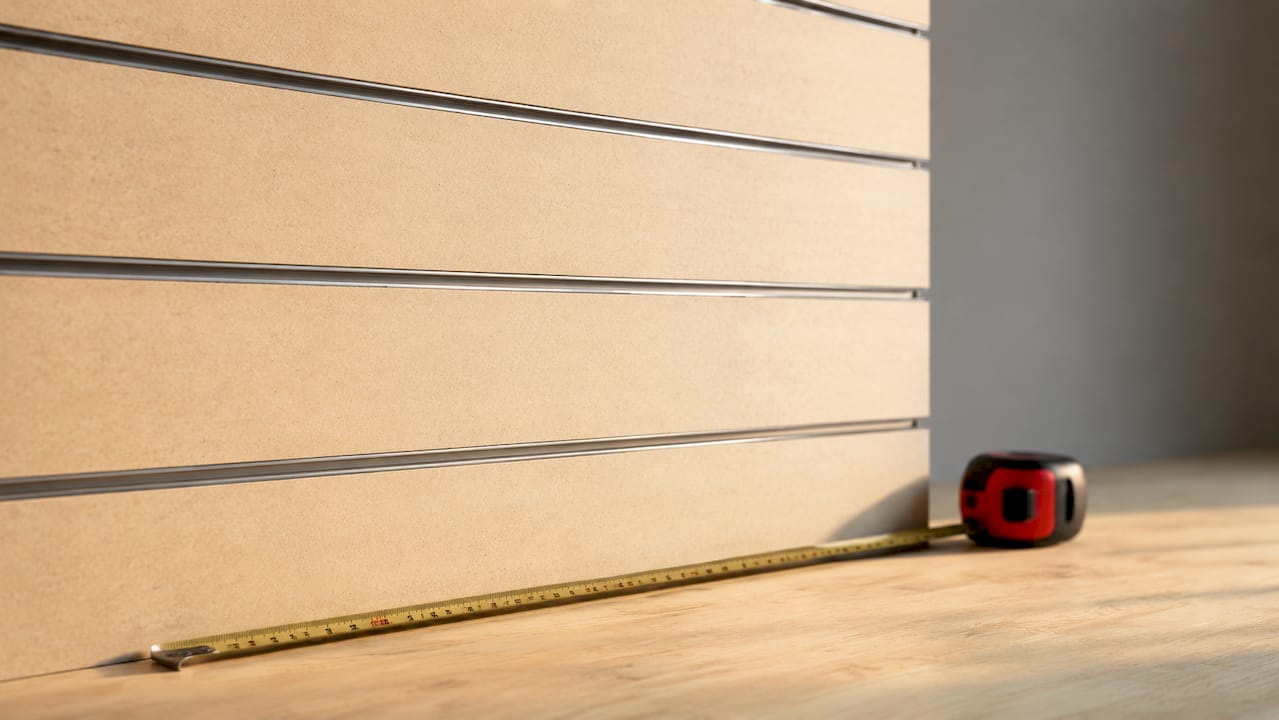
The industry term for these panels is “slatwall,” though you will also see them described as slot wall panels or groove panels in trade catalogues. The standard groove spacing is 3 inches centre-to-centre (approximately 75mm), which is the measurement that determines accessory compatibility. Panels with non-standard spacing reduce your accessory options significantly. DirectShopfittings stocks panels at 100mm pitch, a common commercial spacing that suits the majority of UK retail accessories.
What materials are slatwall panels made from?
The three main materials used in slatwall panels are MDF (medium-density fibreboard), PVC, and composite board. Each has a distinct performance profile, and choosing the wrong one for your environment is a costly mistake.
MDF slatwall is the most widely used option in UK retail. It machines cleanly, accepts a wide range of decorative finishes, and costs less than PVC alternatives. The weakness is moisture. MDF panels swell and chip in humid or greasy environments, which makes them unsuitable for food retail, fishmongers, or areas near kitchen extraction. For a dry fashion boutique or a bookshop, MDF performs well for years.
PVC slatwall costs more upfront but is the correct choice for humid or greasy environments. It does not swell, warp, or absorb moisture. Professional installers recommend PVC for pharmacies, health food shops, and any retail space with fluctuating temperature or humidity. The surface is also easier to wipe clean, which matters in food-adjacent retail.
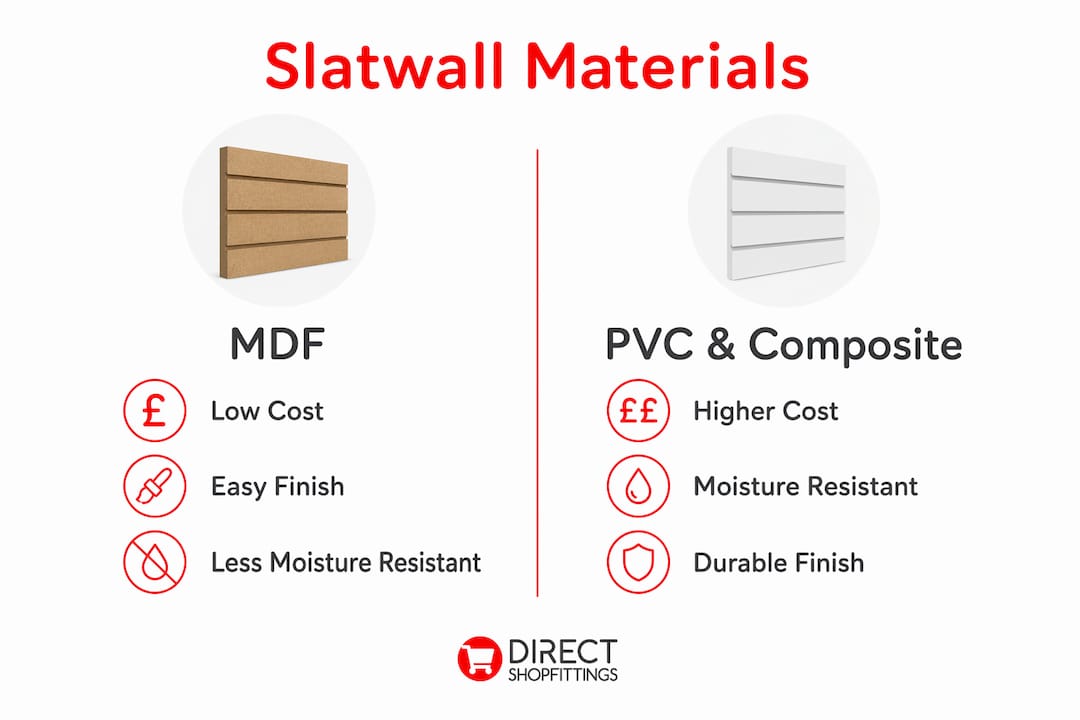
Composite panels combine an MDF core with a moisture-resistant outer layer. They sit between MDF and full PVC in both price and performance. They are a reasonable compromise for semi-humid environments where full PVC feels like overkill.
Finish quality is a separate consideration from the base material. High-pressure laminates maintain their appearance far longer than cheaper foil wraps, which degrade within 12–24 months under retail lighting and handling. A panel that looks worn after one year undermines the professional image you are trying to project.
Pro Tip: Choose your finish before you choose your accessories. A walnut finish panel or a black finish panel sets the visual tone of your entire display wall. Accessories in chrome or brushed steel read very differently against each finish.
| Material | Cost | Moisture resistance | Finish options | Maintenance |
|---|---|---|---|---|
| MDF | Low | Poor | Wide range | Wipe clean; avoid damp |
| PVC | High | Excellent | Limited | Wipe clean easily |
| Composite | Medium | Moderate | Moderate range | Wipe clean; some care needed |
How do slatwall panels function as a display system?
The mechanical design of a slatwall panel is straightforward, but the details determine whether your display holds up under real retail conditions. Each horizontal groove is a T-shaped channel. Accessories have a corresponding T-shaped lip that slides into the channel and locks downward under the weight of merchandise. The fit must be tight enough to prevent wobble but loose enough to allow repositioning.
Reinforced groove inserts, made from aluminium or PVC strips, are fitted inside the channels of quality panels. These inserts distribute weight evenly across the groove walls and maintain the precise channel shape over time. Without inserts, the MDF groove walls compress under repeated loading and accessories begin to wobble. This is the single biggest quality difference between budget panels and commercial-grade panels.
Key functional features to assess when selecting slatwall panels:
- Groove spacing: Standard 75mm or 100mm pitch determines which accessories fit. Always confirm compatibility before ordering accessories in bulk.
- Insert material: Aluminium inserts outperform PVC inserts for heavy merchandise. Confirm inserts are included, as some budget panels omit them.
- Panel thickness: Thicker panels (typically 18mm) carry more weight and resist bowing under load.
- Edge profile: Tongue-and-groove edges allow panels to join without visible gaps, creating a continuous wall finish.
- Accessory range: Hooks, shelves, baskets, clothing rails, and display arms are all standard. Metal accessories carry greater weight and last longer than plastic equivalents.
Pro Tip: Metal hooks and brackets increase hanging capacity and outlast plastic accessories in busy retail environments. Specify metal fittings from the outset rather than upgrading after the first breakage.
Slatwall vs slatgrid: what is the difference?
Slatwall and slatgrid are both wall-mounted display systems, but they serve different purposes and suit different retail contexts. Understanding the distinction saves you from buying the wrong system.
A slatgrid (also called a slat grid panel or grid wall) is a metal mesh panel with a grid of horizontal and vertical wires. Accessories clip onto any intersection of the grid, which means you can adjust them both horizontally and vertically. This gives slatgrid more positioning flexibility in theory. In practice, slatgrid has lower load capacity and a less finished visual appearance. The open mesh look reads as utilitarian rather than premium, which is why slatgrid is common in market stalls and temporary displays rather than permanent retail fixtures.
Slatwall panels only allow horizontal adjustment of accessories, since the grooves run in one direction. However, slatwall is preferred in high-end retail for its clean, finished surface. The solid face between grooves gives the wall a polished look that slatgrid cannot match. Slatwall also carries heavier loads when correctly installed with reinforced inserts and proper wall fixings.
| Feature | Slatwall | Slatgrid |
|---|---|---|
| Adjustment direction | Horizontal only | Horizontal and vertical |
| Load capacity | High (with inserts) | Lower |
| Visual finish | Clean and polished | Open mesh, utilitarian |
| Best use case | Permanent retail fixtures | Temporary or portable displays |
| Accessory compatibility | Wide commercial range | Clip-on grid accessories |
| Cost | Moderate to high | Generally lower |
Slatgrid suits pop-up shops, trade shows, and lightweight seasonal displays. Slatwall suits permanent shop walls, fitting rooms, and any display where appearance and load capacity matter.
How to install and maintain slatwall panels effectively
Correct installation is as critical as panel quality in maintaining load capacity and longevity. A well-chosen panel fitted poorly will fail under load. Follow these steps for a secure, professional result.
- Locate wall studs or uprights. Use a stud finder to mark stud positions across the installation area. Slatwall panels must be anchored to studs using appropriate fasteners: wood screws for timber stud walls, self-drilling metal screws for steel stud partitions, and masonry anchors for solid brick or block walls.
- Plan your layout before cutting. Measure the wall height and width carefully. Panels with tongue-and-groove edges join horizontally to cover long walls without gaps. Sketch the panel arrangement to minimise offcuts and align grooves across adjacent panels.
- Fix the first panel plumb and level. Use a spirit level. The first panel sets the reference for every subsequent panel. A panel fixed even slightly off-level will cause visible misalignment across a long wall run.
- Screw at every stud crossing. Do not rely on adhesive alone. Screw spacing should follow the panel manufacturer’s recommendation, typically every 400mm vertically at each stud. Correct screw spacing prevents panel distortion under heavy or clustered accessory loading.
- Fit accessories and test load before opening. Hang your heaviest planned merchandise load and check for any panel flex or accessory wobble. Address any movement before the shop opens.
For maintenance, wipe MDF panels with a dry or lightly damp cloth. Avoid saturating the surface. PVC panels tolerate wet cleaning. Inspect groove inserts periodically for compression or cracking, particularly in high-traffic areas where accessories are repositioned frequently.
What benefits do slatwall panels offer retail businesses?
Slatwall panels deliver a combination of flexibility, durability, and visual appeal that fixed shelving cannot match. The core benefits for retail business owners are:
- Rapid display changes. Accessories slide out and reposition without tools. A full wall layout change takes minutes, not hours. This matters when you rotate seasonal stock or respond to sales data.
- Vertical space use. Slatwall turns an entire wall height into usable display area. Floor space is expensive; wall space is often wasted. Slatwall panels recover that space efficiently.
- Professional appearance. Quality finishes such as light rustic oak or pewter create a retail environment that looks considered and well-invested. Cheap display solutions undermine customer confidence.
- Accessory variety. One panel system supports hooks, shelves, baskets, clothing rails, literature holders, and display arms. You are not locked into a single product category.
- Long-term durability. Commercial-grade panels with aluminium inserts and high-pressure laminate finishes withstand years of daily use in busy retail environments.
The ability to reconfigure without redrilling is the feature retail business owners value most. It removes the cost and disruption of a full shopfit every time your product range changes.
Key takeaways
Slatwall panels are the most practical wall-mounted display system for permanent retail fixtures, combining load capacity, accessory flexibility, and a professional finish that slatgrid cannot replicate.
| Point | Details |
|---|---|
| Material choice matters | Select PVC for humid environments and MDF with high-pressure laminate for dry retail spaces. |
| Groove inserts are non-negotiable | Aluminium or PVC inserts prevent accessory wobble and extend panel lifespan under load. |
| Standard spacing is 75–100mm | Confirm groove pitch before ordering accessories to avoid compatibility problems. |
| Installation must anchor to studs | Screwing to studs at correct spacing prevents panel distortion and maintains rated load capacity. |
| Slatwall outperforms slatgrid for permanent fixtures | Slatwall carries more weight and delivers a cleaner finish than slatgrid for fixed retail walls. |
Why finish quality is the decision most retailers get wrong
After years of working with retail display systems, the mistake I see most often is retailers choosing panels based on price per square metre and ignoring finish quality entirely. A budget panel with a foil wrap looks fine on day one. By month six, the foil is lifting at the edges and the grooves are showing wear marks. The display wall that was meant to project quality is now doing the opposite.
The second mistake is skipping reinforced groove inserts. Retailers assume all slatwall panels are structurally equivalent. They are not. A panel without aluminium inserts will develop accessory wobble within months of heavy use. Once the groove walls compress, the panel cannot be repaired. You replace the whole section.
My honest advice: treat the panel specification the same way you treat your product buying. Know exactly what you are getting. Ask the supplier whether inserts are included, what the laminate specification is, and what the rated load per accessory point is. DirectShopfittings provides panels across a range of finishes, from cream to maple, with clear specifications. That transparency is what you should expect from any supplier.
The retailers who get the most from slatwall are the ones who plan their accessory layout before the panels go up. They know which grooves will carry clothing rails, which will hold shelves, and which will take single-arm hooks. That planning prevents overloading concentrated areas and keeps the display looking intentional rather than improvised.
— Lee
Shopfitting solutions from DirectShopfittings
Slatwall panels are one component of a well-fitted retail space. Choosing the right panels, accessories, and supporting fixtures together produces a store that works efficiently and looks the part from day one.

DirectShopfittings supplies slatwall panels across a full range of finishes and pitches, alongside the accessories, shelving, and racking that complete a retail environment. Whether you are fitting out a boutique or a multi-unit chain, their supplier network sources hard-to-find items quickly, keeping your project on schedule. If you are new to shopfitting, the shopfitting guide for small retailers is a practical starting point for understanding what your store needs. For a broader view of display options, the retail fixtures guide for new stores covers the full range of fixture types alongside slatwall systems.
FAQ
What is a slatwall panel used for in retail?
A slatwall panel is used to display merchandise on walls using adjustable hooks, shelves, baskets, and rails that slot into horizontal grooves. Retailers use them to maximise wall space and reconfigure product layouts without drilling.
What groove spacing do slatwall panels use?
Standard slatwall panels use a groove spacing of 3 inches (approximately 75mm) centre-to-centre, though 100mm pitch is also common in UK retail. Confirming pitch before purchasing accessories prevents compatibility problems.
What is the difference between slatwall and slatgrid?
Slatwall panels have a solid face with horizontal grooves and suit permanent, high-load retail fixtures. Slatgrid is an open metal mesh that allows vertical and horizontal accessory adjustment but carries less weight and has a less finished appearance.
Do slatwall panels need reinforced inserts?
Commercial-grade slatwall panels include aluminium or PVC inserts inside the grooves to distribute weight evenly and prevent accessory wobble. Budget panels without inserts degrade faster under regular retail use.
Can slatwall panels be installed on any wall?
Slatwall panels can be fixed to timber stud, metal stud, and masonry walls using the appropriate fasteners. Anchoring to studs rather than plasterboard alone is required to sustain the rated load capacity of the panel.